%20(1).jpg)


Tantra Yoga vs Laya Yoga vs Yoga Vasistha
The world of yoga becomes considerably richer once we move beyond the idea that yoga is simply a collection of physical postures.
Across centuries of Indian spiritual thought, yoga has included philosophical enquiry, meditation, mantra, breath practices, ritual, contemplation, disciplined awareness and approaches to the subtle body. This is why terms such as Tantra Yoga, Laya Yoga and Yoga Vasistha can appear related while describing rather different ways of approaching inner development.
They are not simply three competing versions of the same yoga class.
Yoga Vasistha is principally associated with a major philosophical and contemplative Sanskrit text centred on consciousness, self-knowledge and liberation.
Laya Yoga is traditionally associated with absorption or dissolution, particularly the quietening or dissolution of ordinary mental activity into deeper states of awareness.
Tantra Yoga belongs to a much broader and historically diverse collection of Tantric traditions. Depending on the tradition, its methods can involve meditation, mantra, visualisation, ritual, breath, subtle-body contemplation, chakras and Kundalini.
The boundaries are not absolute. Indian spiritual traditions have influenced one another for centuries, and scholars recognise considerable interaction between Yoga, Tantra and later Hatha traditions.
Understanding their differences therefore requires something more sophisticated than asking which one is “best”.
The better question is:
What does each path emphasise, how does it approach transformation, and what kind of learner might be drawn to it?
The Quick Difference Between Yoga Vasistha, Laya Yoga and Tantra Yoga
At the simplest level:
Tradition | Primary emphasis | Characteristic approach |
Yoga Vasistha | Self-knowledge and liberation | Philosophical enquiry, contemplation, meditation and examination of consciousness |
Laya Yoga | Dissolution or absorption of mental activity | Meditation, inner attention, sound and subtle awareness |
Tantra Yoga | Transformation through an integrated spiritual system | Mantra, meditation, breath, visualisation, ritual and subtle-body practices, depending on lineage |
The comparison becomes more interesting when we understand what those descriptions actually mean.
First: Is “Vashishta Yoga” Really a Type of Yoga?
This is one of the most important distinctions for anyone researching the subject.
You may encounter the expression Vashishta Yoga, particularly on general yoga websites. However, the more historically recognised term is Yoga Vasistha, also written Yoga Vāsiṣṭha.
Yoga Vasistha is a substantial Sanskrit philosophical text structured primarily around conversations between the sage Vasistha and Prince Rama.
It explores questions including consciousness, suffering, freedom, self-knowledge, perception, mental conditioning and liberation. The work incorporates stories and philosophical discussions rather than presenting a modern sequence of yoga postures.
Scholarly discussions describe the Yoga Vasistha as a distinctive synthesis rather than something that fits neatly into a single philosophical school. Its development also reflects interactions among several streams of Indian philosophical and yogic thought.
So when comparing Vashishta Yoga vs Laya Yoga vs Tantra Yoga, it is more accurate to think of Yoga Vasistha as a philosophical and contemplative framework rather than another branded yoga style.
That difference matters.
A person studying Yoga Vasistha might spend considerable time investigating the nature of the mind or examining how perception shapes experience. Someone practising a form of Laya Yoga might place greater emphasis on meditative absorption. A Tantra Yoga practitioner may work with an integrated collection of contemplative and ritual methods.
All three may ultimately address liberation or transformation, but they enter the enquiry through different doors.
What Is Yoga Vasistha?
Yoga Vasistha is one of the substantial philosophical works associated with the Indian yoga tradition.
Its literary setting presents Prince Rama questioning the nature of life after becoming deeply dissatisfied with ordinary worldly experience. The sage Vasistha responds through philosophical teaching, stories, metaphors and contemplative enquiry.
The text examines fundamental questions:
What is the mind?
Why do human beings experience limitation?
What is the relationship between perception and reality?
Can conditioning be overcome?
What does genuine freedom mean?
What role does personal effort play in transformation?
One particularly notable theme is the importance given to self-effort rather than passive fatalism. Modern scholarship also highlights the Yoga Vasistha’s distinctive non-dual position and its complex relationship with other traditions rather than reducing it to a simple extension of one school.
What Is the Main Goal of Yoga Vasistha?
At its deepest level, Yoga Vasistha is concerned with liberation through insight into consciousness and the nature of experience.
Its path is therefore highly reflective.
Imagine observing a room through coloured glass. Everything inside appears tinted by the glass even though the room itself has not necessarily changed.
Yoga Vasistha repeatedly invites the seeker to investigate the equivalent “glass” within the mind: assumptions, conditioning, desires, interpretations and identification.
The question becomes not simply:
“How can I change the world around me?”
but:
“What is creating my experience of this world?”
This contemplative orientation distinguishes Yoga Vasistha from yoga systems built primarily around posture or energetic technique.

What Is Laya Yoga?
The Sanskrit word laya is commonly translated in this context as dissolution, absorption or merging.
Laya Yoga therefore describes approaches in which ordinary mental activity is progressively absorbed into subtler states of awareness.
Traditional descriptions frequently connect Laya practice with meditation and inner sound or nada. Some traditions also integrate ideas concerning chakras, Kundalini and the subtle body.
Sources describing Laya Yoga emphasise the dissolution of mental activity through contemplative absorption, including attention to inner sound.
Importantly, Laya Yoga is not necessarily a universally standardised system.
Two teachers using the term may emphasise different methods.
One may focus primarily on meditation.
Another may use mantra.
Another may introduce subtle-body contemplation.
Another may connect Laya closely with Kundalini or Hatha Yoga.
This variation is not unusual when studying historical yoga traditions. Categories that appear perfectly separate on a modern website were often much more interconnected in practice.
What Does “Dissolution” Mean in Laya Yoga?
The word can sound dramatic, but it does not necessarily refer to destroying the personality or escaping ordinary life.
It is better understood as the temporary or progressive quietening of the habitual processes through which the mind continually constructs distinctions.
Consider what happens during deep concentration.
For a moment, awareness becomes so completely absorbed that ordinary commentary fades into the background.
The constant internal narration—
“What should I do next?”
“Did I make the right decision?”
“What does this person think of me?”
“What happened yesterday?”
—may become quieter.
Laya traditions explore deeper forms of this absorption.
Rather than continually adding new experiences, the practitioner investigates what remains when unnecessary mental activity becomes still.
That gives Laya Yoga a noticeably contemplative character.

What Is Tantra Yoga?
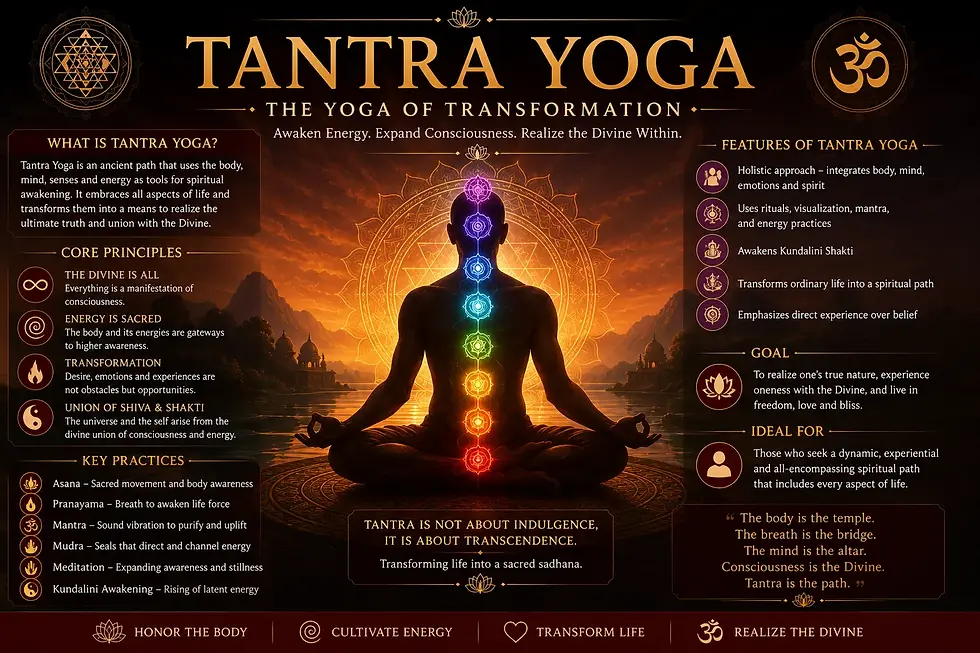
Tantra Yoga is broader and more difficult to define because Tantra itself does not represent one single historical system.
Tantric traditions developed in several religious and philosophical environments and included diverse Hindu and Buddhist forms.
Scholarly histories of yoga identify Tantric systems as important innovators in practices involving mantra, visualisation, meditation, breath and the subtle body. Concepts involving chakras, nadis and Kundalini later became especially influential within other forms of yoga as well.
This immediately challenges one of the most persistent modern misconceptions:
Tantra Yoga is not simply yoga concerned with sexuality.
Some historical Tantric traditions incorporated practices that challenged conventional religious boundaries, but reducing the enormous intellectual and spiritual landscape of Tantra to sexuality removes most of the tradition from view.
Tantra has addressed subjects including consciousness, embodiment, mantra, ritual, devotion, cosmology, meditation, energy and liberation.
Modern Tantra and Neo-Tantra may interpret this heritage differently, particularly in Western settings, but responsible education should distinguish modern adaptations from the full historical tradition.
What Is the Aim of Tantra Yoga?
There is no single answer applicable to every lineage.
Broadly, however, Tantra frequently treats embodied existence as something that can become part of spiritual practice rather than something that must simply be rejected.
Attention, breath, sound, imagination, ritual and awareness can become instruments of transformation.
Certain Tantric yoga systems describe the body through a traditional subtle-body map involving channels called nadis, centres called chakras, and the transformative principle known as Kundalini.
The Medindia reference page places Kundalini awakening at the centre of its definition of Tantra Yoga.
That captures one influential strand of Tantric yoga but does not describe the entire tradition.
Historically, Tantra is much larger.
Tantra Yoga vs Laya Yoga vs Yoga Vasistha: Seven Important Differences
1. Their Starting Point Is Different
Yoga Vasistha often begins with enquiry.
It asks you to examine mind, consciousness, perception and identity.
Laya Yoga begins more directly with absorption.
It asks what happens when ordinary mental movement becomes quiet.
Tantra Yoga tends to begin with transformation through an integrated system of practice.
It can use the body, breath, mantra, imagery, meditation and ritual as part of the path.
One asks you to understand.
Another invites you to dissolve.
Another teaches you to transform and integrate.
The categories overlap, but the emphasis changes.
2. Their Relationship With the Body Is Different
Yoga Vasistha is primarily philosophical and contemplative.
Physical yoga is not its defining identity.
Laya Yoga may include bodily techniques, but its central concern is usually absorption and internalisation.
Tantra Yoga frequently gives embodiment a much more explicit role.
This does not mean that every Tantric practice is physical. Many are intensely meditative. Rather, Tantra often treats embodied experience as a potentially meaningful dimension of spiritual practice.
This is one reason Tantra eventually influenced aspects of Hatha Yoga.
Oxford’s overview of yoga history notes that Tantric yoga systems incorporated visualisation, mantra and breath practices together with subtle-body models involving chakras and nadis, while later Hatha traditions developed in interaction with this broader environment.
3. Their Primary Tools Can Differ
A simplified comparison looks like this:
Yoga Vasistha
· philosophical contemplation
· enquiry
· meditation
· self-observation
· investigation of mental conditioning
Laya Yoga
· meditative absorption
· internal attention
· nada or inner-sound contemplation in some traditions
· mantra in some systems
· subtle-body concentration
Tantra Yoga
· meditation
· mantra
· breath practices
· visualisation
· ritual
· subtle-body contemplation
· chakra and Kundalini practices in relevant traditions
These should not be treated as rigid borders.
Mantra can appear within Laya and Tantra.
Meditation appears throughout all three.
Ideas found in Tantric environments also interacted historically with wider yoga traditions.
The distinction is therefore about emphasis, not exclusivity.
4. Their Understanding of Transformation Differs
Yoga Vasistha directs attention towards insight.
Transformation occurs through increasingly clear understanding of consciousness, mind and identification.
Laya Yoga focuses on absorption.
Transformation becomes associated with quietening the patterns that continually recreate ordinary mental separation.
Tantra Yoga often works through integration and transmutation.
Instead of assuming that spiritual life exists only outside ordinary experience, Tantric approaches may
invite practitioners to bring heightened awareness to the forces already present within embodied life.
For a modern learner, this can be expressed simply:
Yoga Vasistha asks, “What am I misunderstanding?”
Laya Yoga asks, “What remains when mental noise becomes quiet?”
Tantra Yoga asks, “How can the energies and experiences of life become part of conscious practice?”
5. Their Use of Subtle-Body Concepts Is Different
Chakras and Kundalini dominate much modern conversation about Tantra Yoga.
Historically, however, subtle-body systems were neither completely uniform nor limited exclusively to Tantra.
Modern scholarship describes Kundalini as having early prominence within Tantric Shaiva sources and notes the later importance of central-channel and chakra models in Tantric yoga literature.
Laya Yoga can also use subtle-body frameworks.
Yoga Vasistha, by contrast, is better known for philosophical enquiry concerning consciousness and liberation than for a standard seven-chakra practice.
It is also wise to distinguish traditional spiritual maps from modern anatomy.
A chakra is best presented in this context as part of a traditional subtle-body framework—not simply declared to be an anatomical organ or nerve centre.
Respecting that distinction makes spiritual education more credible, not less.
Where Do Tantra Yoga and Laya Yoga Overlap?
This is where simple comparison charts can become misleading.
Laya Yoga and Tantra Yoga can share considerable territory.
Both may involve:
· mantra
· meditation
· Kundalini concepts
· chakras
· inner concentration
· breath
· subtle awareness
· transformation of ordinary consciousness
Some Laya traditions are deeply connected with the broader Tantric and Hatha landscape. Traditional
accounts also associate Laya with inner sound and the dissolution of mental activity.
The distinction is therefore often one of orientation.
Laya emphasises the movement toward absorption.
Tantra provides a much broader ritual, philosophical and practical framework within which absorption may be only one element.
You could imagine a grand house.
Laya is one beautifully quiet chamber within the house.
Tantra is closer to an architectural tradition containing many chambers, passageways and methods of moving through them.
That does not make one greater than the other.
It simply explains why the terms sometimes appear together.
Is Laya Yoga the Same as Kundalini Yoga?
Not exactly.
The terms sometimes overlap, especially because both may involve subtle-body concepts and internal energetic practices.
But treating them as synonyms erases important distinctions.
Kundalini Yoga places particular emphasis on Kundalini—the traditional transformative power described in several yogic and Tantric sources.
Laya Yoga places its defining emphasis on laya, or absorption/dissolution.
A Laya practice may therefore involve Kundalini.
But the idea of absorption is what gives Laya Yoga its particular identity.
Is Tantra Yoga the Same as Kundalini Yoga?
Again, no.
Kundalini concepts became extremely important in some Tantric systems, but Tantra Yoga is broader than Kundalini practice alone.
Research examining Tantric yoga traditions notes that Kundalini models have differed across texts and historical periods. The familiar modern seven-chakra model itself should not be projected unchanged onto every earlier Tantric system.
This historical detail is valuable because it allows modern practitioners to appreciate tradition without turning one contemporary model into an invented universal past.
Is Tantra Yoga Mainly About Sexuality?
No.
This is perhaps the misconception most likely to prevent adults from understanding Tantra seriously.
Modern popular culture has frequently isolated one aspect of Tantra and allowed it to represent the whole tradition.
Historically, Tantric traditions have included sophisticated systems of meditation, mantra, ritual, visualisation, devotion, yogic embodiment and metaphysics.
Sexual or intimate dimensions have existed within certain Tantric and modern Neo-Tantric contexts, but they are not an adequate definition of Tantra Yoga.
A mature modern approach can therefore discuss embodiment, relationships, intimacy and personal awareness where relevant without allowing sensationalism to replace education.
For adults who are curious but cautious, that distinction can be liberating in itself.
You do not need to arrive with a particular identity, relationship status or expectation.
You can begin with learning.
Which Path Is Best for You?
There is no universal winner.
The useful question is which emphasis genuinely speaks to your interests.
Yoga Vasistha May Appeal to You If…
You enjoy philosophy.
You continually question the relationship between mind and reality.
You prefer contemplation to highly structured physical practice.
You are interested in consciousness, self-knowledge and non-dual philosophical enquiry.
You appreciate learning through stories, dialogue and reflection.
Laya Yoga May Appeal to You If…
Meditation naturally attracts you.
You are interested in silence, sound and absorption.
You want to explore the difference between ordinary thought and deeper attention.
You prefer an inward-facing contemplative practice.
You already have a meditation foundation and want to understand subtler traditional approaches.
Tantra Yoga May Appeal to You If…
You prefer a multidimensional practice.
You are interested in the relationship between body, breath and awareness.
You want to learn about mantra, chakras, meditation or Kundalini within a wider framework.
You are curious about integrating spiritual awareness with everyday embodied life.
You value both traditional ideas and thoughtful modern interpretation.
Some learners may eventually study all three.
There is no requirement to build your spiritual identity around a single label.
Tantra Yoga for Modern Adults
The strongest modern spiritual education avoids two extremes.
At one extreme, tradition is stripped of its historical context until it becomes little more than lifestyle branding.
At the other extreme, traditional concepts are repeated without explanation and presented as unquestionable scientific facts.
A more mature approach sits between them.
Traditional teachings can be honoured as traditional teachings.
Contemporary science can be discussed as contemporary science.
Personal experience can be respected as personal experience.
Each has its own language and evidential standards.
For adults exploring Tantra Yoga in the UK or US, this distinction is particularly valuable. It allows spirituality to remain spacious without sacrificing discernment.
A well-designed learning environment should also make room for questions.
What is symbolic?
What is historical?
What belongs to a particular lineage?
What has been adapted for contemporary students?
What are the boundaries of a particular exercise?
Is participation optional?
What training does the teacher have?
How are consent and personal limits handled?
Serious spiritual education becomes stronger when these questions are welcomed.
The Importance of Boundaries and Consent in Modern Tantra
Tantra is sometimes approached with uncertainty precisely because popular representations have blurred the distinction between spiritual education and sensationalism.
Professional teaching should make boundaries clear.
Students should understand what a practice involves before agreeing to participate.
Consent should be active rather than assumed.
A learner should be able to decline an exercise without pressure.
Teacher-student boundaries should be understood.
Privacy should be treated respectfully.
No practitioner should be encouraged to ignore physical or psychological discomfort merely because an experience has been described as “energetic” or “spiritual”.
AOMT currently identifies boundaries and consent among the subjects included within its broader training environment, alongside Tantra, meditation, breath and energy-related education.
That is particularly relevant for adult learners entering Tantra for the first time.
What Does “Discreet Tantra in London” Mean in an Educational Setting?
People searching for discreet tantra in London may be looking for very different things.
Some want private spiritual education.
Others want personalised Tantra Yoga instruction.
Some couples want a confidential environment in which to learn together.
Others simply prefer one-to-one education rather than joining a larger group.
“Discreet” should therefore not need to imply secrecy or anything sensational.
In a professional educational context, it can mean privacy, personal attention, respectful boundaries and a calm setting.
AOMT currently advertises both group learning and private/bespoke Tantra education, including London-based options, alongside online study and programmes in other UK and US locations.
For a learner who values privacy, the most useful questions are practical:
Who will teach the session?
What exactly does the programme cover?
Is the session individual, partnered or group-based?
What clothing and participation expectations apply?
What are the boundaries?
What qualifications or experience does the instructor bring?
Can the curriculum be explained before booking?
Professionalism should make these answers easy to obtain.
A Beginner’s Checklist for Exploring Tantra Yoga
Before choosing any Tantra Yoga programme, consider the following.
1. Understand What You Actually Want
Are you primarily interested in meditation?
Philosophy?
Kundalini?
Breathwork?
Embodied awareness?
Relationship development?
Professional practitioner training?
Personal exploration?
Different goals require different learning environments.
2. Read the Curriculum
Do not rely solely on evocative language.
Look for a clear explanation of what will actually be taught.
3. Ask How the School Defines Tantra
There is enormous variation in modern Tantra.
A reputable teacher should be able to explain their approach without pretending that theirs is the only authentic version.
4. Ask About Boundaries
This is especially important for any embodied or partner-based practice.
You should understand expectations before participation.
5. Distinguish Spiritual Claims From Medical Claims
Yoga and meditation can form meaningful parts of a personal wellbeing practice, but spiritual training is not a replacement for appropriate medical or psychological care.
6. Avoid Trying to Force Extraordinary Experiences
Terms such as “Kundalini awakening” can create expectations that something dramatic must happen.
Depth does not require spectacle.
Steady attention, grounded learning and integration may be much more valuable than chasing unusual sensations.
7. Choose Education Over Performance
The finest spiritual environments do not require you to prove how advanced you are.
Curiosity is enough.
Can Yoga Vasistha, Laya Yoga and Tantra Yoga Be Studied Together?
Yes—but they are better studied as complementary perspectives rather than blended until every distinction disappears.
Yoga Vasistha can deepen philosophical enquiry.
Laya Yoga can illuminate the nature of meditative absorption.
Tantra Yoga can broaden the enquiry into embodiment, mantra, ritual, subtle-body awareness and transformative practice.
Studied together, they can reveal something significant about the history of yoga itself:
Yoga has never been only one thing.
Across centuries it became a meeting place for philosophy, meditation, devotion, embodiment and experimentation.
That diversity is part of its richness.
Frequently Asked Questions
What is the main difference between Tantra Yoga and Laya Yoga?
Tantra Yoga is a broad family of transformative practices and philosophies that may involve meditation, mantra, breath, visualisation, ritual and subtle-body concepts. Laya Yoga places more specific emphasis on meditative absorption or dissolution of ordinary mental activity.
Is Vashishta Yoga the same as Yoga Vasistha?
“Vashishta Yoga” is sometimes used online, but Yoga Vasistha is the more established name for the Sanskrit philosophical work associated with teachings delivered by sage Vasistha to Prince Rama. It is better understood as a philosophical and contemplative text than as a standardised modern yoga class.
Does Tantra Yoga involve physical yoga poses?
It can, depending on the school, but posture is not what defines Tantra Yoga. Historical Tantric systems have given major roles to meditation, mantra, breath, visualisation, ritual and subtle-body practices.
Does Tantra Yoga always involve Kundalini?
No. Kundalini became highly important within influential Tantric and later yogic traditions, but Tantra is broader than Kundalini alone.
Does Laya Yoga use chakras?
Some Laya Yoga traditions use chakra and subtle-body models, particularly where the practice overlaps with Tantra, Kundalini or Hatha Yoga. Other presentations emphasise meditation and inner sound more strongly.
What does laya mean?
In this yogic context, laya generally refers to dissolution, absorption or merging. Laya Yoga therefore focuses on increasingly deep meditative absorption.
Is Tantra Yoga sexual?
Tantra cannot accurately be reduced to sexuality. Some historical and contemporary Tantric contexts have addressed sexuality or intimacy, but Tantra also contains extensive traditions of meditation, mantra, ritual, philosophy, embodiment and spiritual practice.
Is Tantra Yoga suitable for beginners?
Introductory Tantra Yoga can be appropriate for beginners when the curriculum is clearly explained and practices are taught responsibly. Intensive breath, meditation or Kundalini-oriented techniques deserve particularly careful instruction.
Can I practise Tantra Yoga without a partner?
Yes. Many Tantric practices are individual practices involving meditation, breath, mantra, contemplation or awareness. Partner work belongs only to particular modern courses or approaches.
What should I look for in a Tantra teacher?
Look for clarity, experience, transparent boundaries, respect for consent, realistic claims, a defined curriculum and an ability to distinguish traditional spiritual concepts from medical facts.
Can Tantra Yoga and meditation be practised together?
Yes. Meditation has been central to many Tantric systems. Modern Tantra Yoga programmes may integrate meditation with breath, mantra, visualisation and embodied awareness.
Where can adults learn Tantra Yoga in London?
Options range from group workshops to private educational programmes. AOMT currently provides Tantra-related learning in London alongside other UK locations, online programmes and US-based education. Prospective students should review the current curriculum and format before booking.
Tantra Yoga, Laya Yoga or Yoga Vasistha: Which Door Will You Open?
The difference between these traditions becomes much clearer once we stop trying to compress them into simple yoga categories.
Yoga Vasistha invites profound enquiry into consciousness, perception, mind and liberation.
Laya Yoga turns attention inward towards absorption and the quietening of ordinary mental activity.
Tantra Yoga offers a wider transformative landscape in which meditation, mantra, breath, ritual, embodiment and subtle awareness may all become part of spiritual practice.
Their histories overlap.
Their techniques sometimes meet.
Their vocabulary can intersect.
Yet each offers a distinctive lens through which to investigate awareness.
For the modern adult learner, perhaps the most valuable approach is therefore not to rush towards the most mysterious-sounding practice.
Begin with education.
Ask questions.
Respect your boundaries.
Understand the tradition behind the terminology.
Then choose the path—or combination of paths—that genuinely deepens awareness rather than simply adding another label to your life.
At the Academy of Modern Tantra (AOMT), students can explore Tantra and related holistic disciplines through structured learning designed for personal development as well as practitioner education, with online and in-person options in the UK and US.
Explore AOMT’s Tantra Yoga learning opportunities and discover which approach feels aligned with the next stage of your journey.


Comments