%20(1).jpg)


Seasonal Frequencies & the Wolf Moon: A Tantra Yoga Path to Authentic Frequency
There are moments in the year when life appears to speak more quietly.
Winter is one of them.
The evenings lengthen. Morning arrives differently. Gardens withdraw into themselves. Trees expose their architecture. In northern climates especially, the abundance of summer gives way to a landscape that asks less for performance and more for listening.
It is easy to call this a change in “frequency”.
But what do we actually mean by that?
Within a refined spiritual practice, seasonal frequency does not need to mean an invisible force measured in mysterious units or a cosmic mechanism controlling our emotions. It can describe something subtler and more useful: the changing quality of our relationship with light, darkness, rest, activity, attention, nature and ourselves.
The physical season is real.
Our interpretation of the season is personal.
And between the two lies a fascinating space for contemplative practice.
This is where Tantra Yoga offers a particularly rich perspective.
Rather than asking us to escape ordinary life in order to become spiritual, Tantra can invite us to meet experience more consciously—to observe breath, sensation, thought, emotion, relationship and environment with greater attention.
The January full moon, commonly known as the Wolf Moon, provides a beautiful symbolic threshold for this practice.
Not because we need to believe that the Moon dictates our destiny.
But because human beings have always used recurring moments in nature to remember what everyday life makes us forget.
The Wolf Moon can become such a moment.
A mirror.
A pause.
A winter chamber in which we ask:
When the noise becomes quieter, what in me is actually true?
That question is the beginning of authentic frequency.
What Are Seasonal Frequencies?
The word frequency has a precise meaning in physics, but contemporary spiritual language often uses it much more broadly.
People speak of raising their frequency, changing their vibration, feeling another person's energy or entering a different energetic state.
These expressions may have deep personal meaning, but they should not automatically be mistaken for scientific measurements.
At AOMT, a more grounded way to approach seasonal frequencies is to understand them as changing patterns of experience.
Winter feels different from summer.
Dawn feels different from midnight.
A busy city has a different psychological texture from a silent forest.
The beginning of a year may feel different from its middle because our culture gives that moment particular significance.
None of this requires a supernatural explanation.
Our external environment continually influences what captures our attention, how we organise our days and how we experience ourselves within time.
Seasonal awareness therefore begins with something remarkably simple:
Notice the light.
Notice your energy.
Notice how much rest you require.
Notice whether your attention naturally turns outward or inward.
Notice what you are trying to force.
Notice what becomes visible once some of the activity falls away.
Tantra Yoga is especially suited to this kind of enquiry because awareness itself becomes part of the practice.
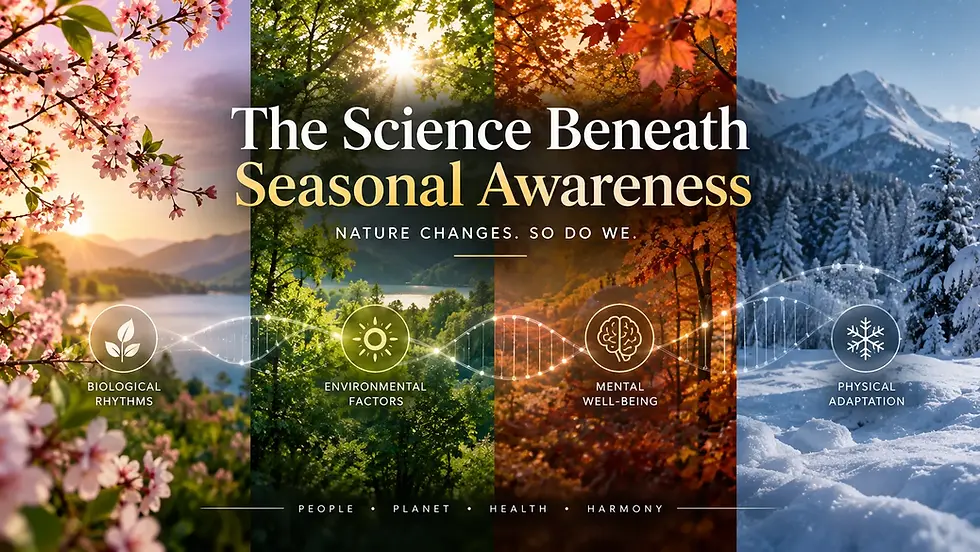
The Science Beneath Seasonal Awareness
There is an elegant meeting point between ancient seasonal awareness and modern chronobiology, provided we do not exaggerate what either one proves.
Humans possess circadian systems that are strongly influenced by patterns of light and darkness. Light reaching the eyes helps synchronise the body's internal clock with the approximately 24-hour environmental cycle, affecting sleep and wakefulness among other biological processes.
Changing light exposure across the year can therefore matter.
For some people, winter is associated with marked changes in mood, energy, concentration and sleep. Seasonal affective disorder is a recognised form of depression that commonly occurs during winter, although seasonal patterns can differ between individuals. The NHS notes that reduced daylight is thought to play a role in these seasonal changes.
That gives us a meaningful foundation for discussing seasonal rhythms without inventing mechanisms.
Winter truly does change the light environment.
The body truly does respond to light.
People truly can experience seasonal changes differently.
But this is not the same as claiming that the winter solstice transmits a mystical frequency directly into human tissue.
Luxury spiritual practice does not become less beautiful when we make this distinction. It becomes more intelligent.
What Is the Wolf Moon?
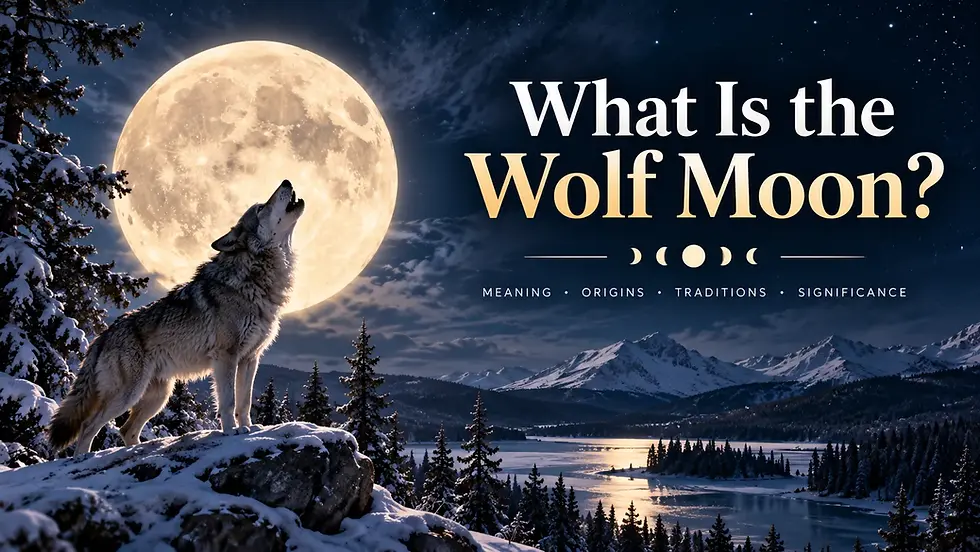
The Wolf Moon is the popular name given to January's full moon.
The name is commonly associated with winter wolf activity and appears in modern collections of traditional full-moon names. Research into the name's history points particularly toward Celtic and Old English associations, alongside a much wider mixture of naming traditions that have become blended within contemporary calendars.
This makes an important point.
The Wolf Moon is not a separate astronomical type of moon.
Astronomically, it is a full moon occurring in January.
Its additional significance comes from story, culture and symbolism.
And symbolism can be extraordinarily powerful without pretending to be physics.
Consider the wolf.
It evokes instinct.
Attention.
Territory.
Belonging.
Listening.
Communication.
Social intelligence.
Solitude balanced with community.
Movement through darkness.
The ability to remain alert without continuously making noise.
These qualities make the wolf an unusually compelling winter archetype.
The question therefore becomes not:
“What is the Wolf Moon doing to me?”
but:
“What does the Wolf Moon allow me to notice?”
That subtle change places authority back within the practitioner.
Does the Full Moon Actually Affect Us?
This question deserves a nuanced answer.
Research investigating possible lunar effects on human sleep has produced conflicting findings.
A 2021 study examining communities with different levels of access to artificial light found that participants tended to sleep later and for less time during nights preceding the full moon. The researchers proposed that evening moonlight may have historically extended nocturnal activity.
However, a later analysis involving two large consumer-device datasets and tens of millions of recorded nights found no meaningful effect of moon phase on total sleep time.
The responsible conclusion is not that the Moon definitely influences human emotion, nor that every lunar practice is meaningless.
It is simply that strong biological claims about the full moon should be made cautiously.
There is another way to work with it.
A full moon is visible.
Memorable.
Recurring.
Historically significant.
It can therefore function as a calendar for contemplation.
That is enough.
You do not need the Moon to control your nervous system in order to sit beneath it and become aware of your life.

What Does Authentic Frequency Mean?
“Authentic frequency” can sound abstract until we translate it into ordinary human experience.
For AOMT, the phrase can be understood as the quality of inner congruence that emerges when thought, feeling, body awareness, values and behaviour are no longer constantly pulling in opposing directions.
Imagine saying yes when your entire body wishes to say no.
Externally there is agreement.
Internally there is friction.
Or imagine wanting intimacy while continually behaving in ways that prevent vulnerability.
Again, there is friction.
You might describe such moments spiritually as being “out of frequency”.
Psychologically, you might call them incongruence.
In everyday language, you might simply say:
“This doesn't feel like me.”
Authentic frequency is the movement in the opposite direction.
It is not constant happiness.
It is not permanent calm.
It does not mean getting everything we desire.
It is the growing capacity to recognise what is genuinely happening within us and respond without
unnecessary self-deception.
Sometimes authenticity feels expansive.
Sometimes it feels uncomfortable.
Sometimes the most authentic response is enthusiasm.
Sometimes it is rest.
Sometimes it is a clear boundary.
Sometimes it is admitting that we do not yet know.
This is where the idea becomes deeply Tantric.
Where Tantra Yoga Enters the Seasonal Path
Historical Tantra represents an enormous and diverse collection of traditions rather than one uniform practice.
Meditation has been important within Hindu and Buddhist Tantric traditions, with methods that have included visualisation, ritual, mantra and contemplative work with models of the subtle body. Scholars also emphasise that Tantra developed numerous different subtle-body systems rather than one universally fixed anatomy.
Modern Tantra Yoga inherits and adapts elements of this much wider landscape.
At AOMT, Tantra Yoga is presented as a practice concerned with conscious living rather than simply physical exercise, with structured courses incorporating awareness and related contemplative methods.
That makes Tantra especially interesting within a seasonal framework.
A conventional New Year's approach can sound like this:
What should I achieve?
Tantric enquiry introduces different questions:
What am I experiencing?
Where am I disconnected?
What is my body communicating?
Which desires are genuine and which are inherited expectations?
Where do I abandon my boundaries to maintain approval?
What happens when I stop rushing toward the next version of myself?
The Wolf Moon pathway does not therefore need to become another manifestation programme.
It can become a return to attention.

The Five Gates of Authentic Frequency
A useful AOMT framework is to approach seasonal Tantra Yoga through five gates:
Stillness → Sensation → Discernment → Expression → Integration
These are not ancient Tantric categories being presented as historical doctrine.
They are a contemporary reflective framework inspired by the broader Tantric emphasis on awareness, embodiment and practice.
Together they create a pathway from simply experiencing something to actually living differently.
Gate One: Stillness
Winter naturally offers an image of stillness.
The seed beneath soil does not appear active.
The bare tree appears to have ceased producing.
The long evening can feel empty compared with the sensory abundance of summer.
Modern culture often interprets this kind of stillness as failure.
No visible progress.
No announcement.
No achievement.
No transformation worth posting.
Tantra Yoga offers another possibility.
Stillness can be an encounter.
Sit comfortably.
Allow the spine to find its natural dignity without becoming rigid.
Let the breath arrive without immediately manipulating it.
For several minutes, do nothing more sophisticated than notice.
Where is the body supported?
Where is effort unnecessary?
Where does the mind repeatedly travel?
What sensation appears when you stop distracting yourself?
The purpose is not to achieve a mystical state.
The purpose is to discover what becomes perceptible when performance stops.
For a winter practice, this is profound.
Because authentic frequency cannot be heard clearly while every silence is immediately filled.
Gate Two: Sensation
Once stillness is available, sensation becomes easier to perceive.
Tantra has historically given considerable importance to embodiment, although traditional conceptions of the Tantric or subtle body should be understood within their own religious and ritual contexts rather than equated automatically with modern physiology.
For the contemporary practitioner, embodiment can begin much more simply.
Feel the temperature of your hands.
Notice the movement of the ribs.
Observe where breathing appears spacious and where it feels guarded.
Feel the contact between your body and the floor.
Notice pressure, warmth, movement and stillness.
Nothing extraordinary needs to happen.
In fact, the obsession with extraordinary experience often prevents people from appreciating the subtle intelligence of ordinary sensation.
The Wolf Moon can become a reminder to listen rather than perform.
A wolf crossing a winter landscape does not need constant internal commentary.
It attends.
For a human practitioner, sensation can become part of that attention.
Gate Three: Discernment
Awareness without discernment can become another form of confusion.
Every impulse is not necessarily intuition.
Every strong emotion is not necessarily truth.
Every thought that arrives during meditation is not a message from the universe.
Mature spiritual practice requires discrimination.
After becoming aware of sensation, ask:
What do I actually know?
Perhaps you know that a particular commitment leaves you depleted.
Perhaps you know that you have repeatedly avoided a necessary conversation.
Perhaps you know that your current pace is unsustainable.
Perhaps you know that a relationship matters enough to receive more care.
Perhaps you know that the goal you have been chasing no longer belongs to you.
And perhaps you discover that you do not know.
That can be equally valuable.
There is enormous dignity in replacing false certainty with clear uncertainty.
Authentic frequency does not mean having all the answers.
It means reducing the distance between what you know inwardly and what you are willing to acknowledge outwardly.
Gate Four: Expression
The wolf is popularly associated with its howl, making voice an obvious part of Wolf Moon symbolism.
But expression need not be dramatic.
A clear sentence can be more transformative than a theatrical ritual.
“I need more time.”
“I would like this.”
“I am not comfortable with that.”
“I have changed my mind.”
“I miss you.”
“I need help.”
“I want to understand.”
“I don't know.”
These are expressions of frequency in the most grounded possible sense: inner information becoming outer communication.
Tantric traditions have also placed significant importance on mantra and sacred sound, with mantra functioning within ritual, meditation and yogic practice.
A modern reflective practice can honour the power of sound without claiming that every spoken intention changes quantum reality.
Voice matters because expression matters.
Language changes relationships.
Naming experience changes the way we engage with it.
A mantra can organise attention.
A conscious exhalation can mark a transition.
A carefully spoken boundary can alter the course of an evening—or a life.
Gate Five: Integration
Transformation that exists only during ritual is fragile.
Integration asks a less glamorous question:
What changes tomorrow morning?
Suppose your Wolf Moon reflection reveals that you need greater rest.
Integration might mean changing one evening commitment.
If you recognise that a relationship needs attention, integration might mean scheduling an uninterrupted conversation.
If meditation reveals constant overstimulation, integration might mean beginning the morning before opening social media.
If you recognise a boundary, integration means practising the language required to communicate it.
Tantra Yoga becomes valuable here because practice is not limited to a special room.
Awareness must eventually enter ordinary life.
The real spiritual laboratory is often Tuesday afternoon.This is sufficiently powerful without embellishment.
The Wolf as an Archetype of Instinct and Belonging
The wolf offers another useful tension: individuality and community.
Popular culture often celebrates the “lone wolf”.
Real wolves, however, are social animals.
That makes the symbolism more interesting.
Authenticity does not require isolation.
Nor does belonging require self-erasure.
A mature adult life continually negotiates the space between the two.
Where do I adapt because relationship matters?
Where do I accommodate because I am afraid?
Where does compromise become self-abandonment?
Where does independence become avoidance?
Where do I need community?
Where do I need solitude?
These questions matter whether we are speaking about friendships, partnerships, family relationships, professional environments or spiritual communities.
The Wolf Moon can therefore become a seasonal invitation to examine belonging.
Not:
Who is my mystical pack?
But:
Where can I belong without disappearing?
That is a far more valuable question.
A Refined Wolf Moon Tantra Yoga Practice
A luxurious spiritual ritual does not require an elaborate collection of objects.
Luxury, in this context, can mean the absence of hurry.
Privacy.
Attention.
Quality.
Space.
Choose an evening near the January full moon if the symbolism speaks to you, although the practice can be performed at any point in winter.
Dim artificial lighting.
Place your phone outside the room if practical.
Use a mat, cushion or chair that genuinely supports your body.
You may light a candle if this feels meaningful and safe.
Then move through five stages.
1. Arrive
Sit for several minutes without changing anything.
Allow the eyes to soften.
Notice the room.
Notice your body.
Notice your breathing.
No interpretation is required.
2. Breathe
Allow the breath to become slightly slower without forcing a dramatic technique.
If breath retention makes you uncomfortable, do not use it.
Let the exhalation feel unhurried.
The intention is attention, not endurance.
3. Feel
Move awareness through the body.
Forehead.
Jaw.
Throat.
Shoulders.
Chest.
Abdomen.
Pelvis.
Hands.
Feet.
Ask simply:
Where am I holding effort that I no longer need?
4. Enquire
Open a journal and answer three questions:
What is becoming quieter?
What is becoming clearer?
What deserves an honest response from me?
Do not attempt to sound spiritual.
Write what is true.
5. Integrate
Choose one action small enough to complete within the next seven days.
Not ten intentions.
One.
A conversation.
A boundary.
A morning walk.
A meditation appointment with yourself.
A decision postponed too long.
A course you genuinely wish to explore.
A night of rest.
Authenticity becomes powerful when it becomes specific.
Seasonal Tantra Without Chasing Mystical Experiences
There is a temptation within contemporary spirituality to measure every practice by intensity.
Did energy move?
Did you feel vibrations?
Did you experience a vision?
Did something awaken?
Did you feel the Moon?
This creates an unfortunate hierarchy in which quiet practices appear less advanced than dramatic ones.
Tantra does not need to be approached that way.
The contemplative history of Tantra includes sophisticated meditation, visualisation, ritual and approaches to awareness. It cannot responsibly be reduced to the pursuit of unusual sensations.
For contemporary adults, particularly beginners, a more grounded definition of progress may be valuable.
Perhaps practice is deepening if you notice your reactions earlier.
Perhaps awareness is expanding if you listen before interrupting.
Perhaps embodiment is increasing if you recognise tension before exhaustion.
Perhaps your Tantra Yoga is working when you communicate more clearly.
Perhaps “higher frequency” simply becomes a poetic description for living with less unnecessary
contradiction.
That is not less spiritual.
It may be more demanding.
Relationships, Boundaries and Authentic Frequency
Relationships are where authenticity becomes measurable in behaviour.
It is easy to feel deeply aligned while alone during meditation.
The more revealing question is what happens when another person's desires differ from our own.
This is where boundaries become part of the spiritual practice.
Can you remain present while saying no?
Can you hear someone else's no without interpreting it as rejection?
Can you make a request without turning it into pressure?
Can you change your mind?
Can another person?
Can intimacy and individuality coexist?
AOMT already incorporates boundaries and consent within parts of its educational curriculum, alongside breath, embodiment and Tantra-related learning.
This matters because any contemporary Tantra education should make participation expectations clear.
There should be room for choice.
Room for questions.
Room for privacy.
Room to decline.
A spiritual environment becomes more refined—not less—when boundaries are explicit.
Discreet Tantra in London: Privacy as Part of the Practice
Some adults are naturally comfortable attending large public workshops.
Others are not.
Someone searching for discreet tantra in London may simply want a more private educational environment: personalised guidance, a quieter setting, greater confidentiality or the ability to ask questions they would prefer not to discuss in a group.
There is nothing inherently mysterious about that preference.
Privacy can support depth.
AOMT currently offers private and bespoke learning with its founder, Jennifer Surch, alongside London-based options including private programmes promoted in Mayfair and other locations.
For someone approaching seasonal Tantra Yoga privately, the experience might focus on meditation, personal reflection, embodiment, relationship awareness or establishing a sustainable practice rather than performing for a group.
Before choosing any private Tantra experience, ask practical questions.
What will happen during the session?
What is optional?
What are the boundaries?
Who will be present?
What is the teacher's background?
How is confidentiality handled?
What should you wear or bring?
Is the focus educational, contemplative, relational or therapeutic?
Sophisticated practice begins with clarity.
Winter Tantra Yoga in the UK and US
Seasonal practice changes according to geography.
A winter evening in London is not identical to one in Florida.
Northern parts of the US experience very different winter light exposure from southern states.
The spiritual calendar therefore does not need to become rigid.
Work with the environment you actually inhabit.
In the UK, winter practice may naturally emphasise reduced daylight, indoor reflection and deliberately
seeking daylight during the morning or daytime.
In warmer US locations, the physical experience of January may feel much less withdrawn even though the cultural transition into a new year remains significant.
This illustrates an essential principle:
The season is not an instruction. It is information.
Tantra Yoga asks us to become responsive rather than formulaic.
One person needs more stillness.
Another has spent too long withdrawn and needs movement.
One needs solitude.
Another needs community.
One needs reflection.
Another already understands the problem and needs action.
Authenticity is contextual.
The Seven-Day Wolf Moon Integration Path
The most valuable part of a reflective practice often begins after the candles have been extinguished.
For the week following your Wolf Moon reflection, give each day one quality.
Day 1 — Observe. Do not immediately attempt to improve yourself. Notice the patterns that became visible.
Day 2 — Simplify.Remove one unnecessary demand, distraction or obligation where realistically possible.
Day 3 — Embody.Choose a slow Tantra Yoga, meditation or mindful movement practice and notice sensation rather than performance.
Day 4 — Communicate. Express one thing that has required greater honesty, using language that is clear and respectful.
Day 5 — Receive.Notice what happens when you stop directing everything. Listen to another person. Spend time outside. Allow silence.
Day 6 — Choose.Make one concrete decision arising from the week's observations.
Day 7 — Integrate.Ask what should become a practice rather than remain an insight.

This is how a seasonal ritual enters ordinary life.
It becomes less about the Moon.
More about the quality of attention the Moon helped you remember.
Authentic Frequency Is Not Constant Positivity
One of the least helpful ideas within modern wellness culture is that being spiritually “aligned” should make a person permanently positive.
Human experience is more complex.
Grief has a frequency, if we wish to use that language.
So does uncertainty.
So does anger.
So does tenderness.
So does rest.
The question is not whether an emotion has a “high” or “low” vibration.
The question is whether we can meet it consciously and respond wisely.
Some forms of discomfort contain information.
Others require professional support.
Still others pass when given appropriate rest, time and perspective.
Tantra Yoga can create a contemplative framework, but it should not be used to explain away serious psychological or physical symptoms.
That distinction is particularly important during winter.
If persistent low mood, loss of interest, fatigue, sleep changes or other symptoms begin affecting daily life, seek appropriate health support rather than assuming you simply need to “raise your vibration”.
Seasonal affective disorder and other forms of depression deserve proper assessment and care.
Spiritual practice and responsible healthcare do not need to compete.
The Difference Between Ritual and Magical Thinking
Ritual gives meaning to action.
Magical thinking assigns causal certainty where evidence is absent.
There is a difference.
Writing something you wish to release and then burning the paper safely can be a meaningful ritual.
It marks a decision.
It creates an embodied moment.
It may help the mind recognise transition.
That does not require us to claim that the universe has physically removed an energetic blockage.
Likewise, standing beneath a full moon may create awe, perspective or emotional significance.
Those experiences are real experiences.
They do not require a theory of lunar radiation changing consciousness.
Tantra Yoga becomes more credible when it can hold both poetry and discernment.
The candle can remain beautiful after we understand combustion.
The Moon can remain sacred to us after we understand astronomy.
Mystery does not require misinformation.
The Deeper Meaning of Winter
Nature is often used carelessly as a metaphor for endless productivity.
Spring means start.
Summer means flourish.
Autumn means harvest.
Winter means prepare to begin again.
But perhaps winter deserves to exist on its own terms.
Not everything needs to be preparation for productivity.
There are periods when withdrawal is valuable.
Periods when answers should not be forced.
Periods when the old identity has loosened but the new one has not yet formed.
These spaces can be uncomfortable because they offer fewer external markers.
Tantric awareness asks us to inhabit them.
The darkness between certainty and decision.
The pause between exhalation and inhalation.
The moment before a boundary is spoken.
The silence after a question.
Winter can become a teacher of such spaces.
The Wolf Moon then becomes not an energetic command to manifest more, but a silver marker in the darkness:
You are still here. Pay attention. A Different Kind of Luxury
Luxury is commonly associated with addition.
More objects.
More experiences.
More stimulation.
More access.
Spiritual luxury may be the reverse.
Enough time to hear yourself think.
Enough privacy to say what is true.
Enough confidence to decline what does not belong to you.
Enough attention to experience one breath instead of rushing toward the next sensation.
Enough discernment to enjoy symbolism without surrendering critical thought.
Enough presence to stop treating the current moment as an inconvenience on the way to a better one.
This is where Tantra Yoga becomes especially relevant to a mature adult audience.
It offers the possibility that fullness is not obtained only by accumulating experience.
Sometimes fullness appears when fragmentation decreases.
Frequently Asked Questions
What are seasonal frequencies?
In contemporary spiritual language, seasonal frequencies can describe the changing emotional, environmental and contemplative qualities associated with different times of year. They should not automatically be interpreted as scientifically measured energetic vibrations. Changes in seasonal daylight do have genuine effects on circadian timing and can influence sleep and mood.
What is the Wolf Moon?
The Wolf Moon is a popular name for the January full moon. The name is commonly linked with winter wolf activity and is thought to have Celtic and Old English associations among the mixture of traditions represented in modern full-moon calendars.
Does the Wolf Moon have a special energy?
There is no established scientific evidence showing that the January full moon emits a unique emotional or spiritual energy that changes human consciousness. It can nevertheless carry personal, cultural and symbolic significance, making it a useful focal point for reflection or meditation.
Can the full moon affect sleep?
Research is mixed. Some studies have reported changes in sleep timing around particular lunar phases, while large later datasets have found no meaningful lunar effect on total sleep. It is therefore better not to treat full-moon sleep effects as settled science.
What does authentic frequency mean?
Authentic frequency can be used as a spiritual metaphor for inner congruence: greater alignment between your awareness, values, feelings, boundaries and actions. It does not need to refer to a measurable physical vibration.
How does Tantra Yoga relate to seasonal practice?
Tantra Yoga can bring meditation, breath awareness, embodiment, mantra and conscious attention into seasonal reflection. Rather than assuming that the season controls you, Tantra Yoga encourages awareness of how you are actually experiencing the present moment.
Is Tantra Yoga only a physical yoga practice?
No. Historical Tantric traditions have included meditation, mantra, visualisation, ritual and subtle-body practices as well as influencing later forms of yoga. Contemporary Tantra Yoga programmes vary significantly between schools.
Do I need to believe in astrology to practise a Wolf Moon meditation?
No. You can use the full moon purely as a recurring symbolic moment for contemplation. Astrology, spirituality and astronomical observation do not have to be treated as the same thing.
Is a Wolf Moon ritual suitable for beginners?
A simple practice involving comfortable meditation, gentle breathing, journalling and reflection can be accessible to many beginners. Avoid forcing breathwork, extreme practices or anything that causes physical or psychological discomfort.
What can I release during a Wolf Moon practice?
Rather than trying to “energetically remove” something, identify a practical pattern you are ready to change: an unnecessary commitment, an outdated expectation, a communication habit or a way of treating your own needs.
What is the connection between Tantra and mantra?
Mantra has played an important role in many Tantric traditions, where sacred sound has been used within meditation, ritual and yogic practice.
Can I practise Tantra Yoga alone?
Many forms of meditation, breathing, contemplation, mantra and embodied awareness can be undertaken individually. Other practices may require qualified instruction. The appropriate format depends upon the tradition and technique.
What does discreet tantra in London mean?
For many adults, discreet tantra in London simply means private, confidential or personalised Tantra education rather than a large group environment. AOMT currently offers private and bespoke learning options alongside its wider courses.
Is winter a good time to begin meditation?
There is no universally best season, but the longer evenings and cultural emphasis on reflection can make winter an appealing time to establish a contemplative routine.
Should I use Tantra Yoga instead of therapy for winter depression?
No. Tantra Yoga or meditation can be personal wellbeing practices, but persistent or significant depression requires appropriate professional assessment. In the UK, the NHS recommends seeking help if you think you may have seasonal affective disorder.
Returning to Your Own Frequency
The Wolf Moon does not need to promise transformation.
Its beauty is enough.
Winter does not need to send instructions into your nervous system.
Its change in light is enough to remind you that human life also moves through cycles.
And Tantra Yoga does not need to remove you from the world.
Its invitation may be precisely the opposite:
return.
Return to breath.
Return to sensation.
Return to discernment.
Return to the boundary you have been afraid to express.
Return to the relationship that deserves your complete attention.
Return to the body not as an obstacle, but as part of lived experience.
Return to silence before deciding what must come next.
Perhaps this is what authentic frequency ultimately means.
Not becoming someone more spiritual.
Not forcing yourself into perpetual positivity.
Not broadcasting desires into an invisible universe.
Simply becoming less divided within yourself.
The January Wolf Moon can serve as a beautiful marker on that path: a luminous winter reminder to
listen more carefully to the life already moving through you.
At the Academy of Modern Tantra, adults can explore Tantra Yoga, meditation, embodied awareness and related disciplines through structured education, private learning and wider course experiences.
For those who value privacy, depth and personalised guidance, AOMT also offers private learning opportunities in London and other locations.
The season may open the door.
Awareness is what walks through it.


Comments